Google Ads
Google ads cloaking without a redirect
One URL, one script, and the decision made on the page rather than before it. That choice is the product, and this page explains why it is the right one for Google traffic.
Google's review systems
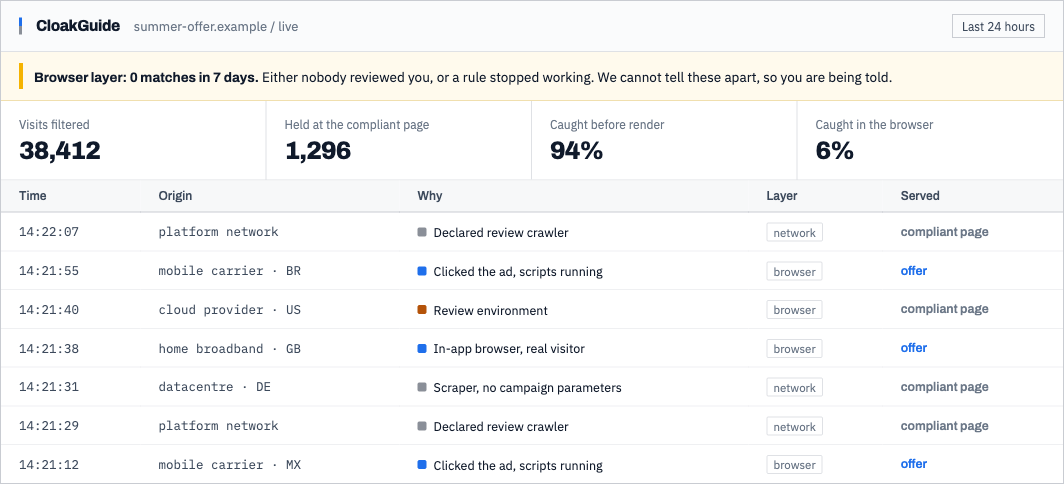
Declared crawler ranges resolve at layer one; third-party scanners arriving from ordinary cloud addresses are handled at layer two.
The compliant page, on the URL you submitted.
People who clicked your ad
Consumer networks, complete headers, a click identifier matching a live campaign.
The offer page, swapped in on that same URL.
Why the decision happens on the page
There are three ways to build this and they differ in one thing: when the decision is made. That decides what evidence exists to make it with.
A redirect filter chooses before the first byte, so it never sees anything the browser knows. For Google traffic that matters more than it does elsewhere, because the review population is not one thing: declared crawlers announce themselves and third-party scanners do not.
Deciding on the page also inverts the default usefully. A redirect must actively recognise a crawler in order to withhold the offer. A page that swaps the offer in withholds it from everything that does not run scripts, without recognising anything at all.
Two mistakes this is built to avoid
Network lookup that silently returns nothing
For some large address ranges, network number lookup returns nothing at all. A filter matching on network number alone reports zero platform traffic while a large source of it walks straight through, and reports it without an error. Layer one never relies on that lookup by itself.
Treating automation and review as one population
Scripted browsers and platform review look nothing alike. The sessions flagged by the classic automation signal turn out to be unrelated automation farms, with no overlap with platform review at all. Collapsing both into one suspicion score gets both wrong, so they are scored separately.
Pricing
Starter
$49 / mo
- 1 site
- 50,000 filtered visits a month
One offer, one landing page, one traffic source.
Growth
$99 / mo
- 5 sites
- 250,000 filtered visits a month
Several offers running at once, across more than one platform.
Scale
$199 / mo
- Unlimited sites
- 1,000,000 filtered visits a month
Agencies and media buyers running for more than one advertiser.
Questions
- Does CloakerHQ redirect on Google Ads traffic?
- No. The URL you put in the ad is the URL that stays in the address bar. The offer is swapped in on that page, so there is no redirect chain and no second domain in the path.
- Why not filter on the server instead?
- Because a server-side filter has to choose before the first byte goes out, when all it knows is the address, the handshake and the headers. That is enough for traffic that announces itself and useless for review traffic arriving from ordinary cloud addresses with completely normal headers, which is the case that actually costs accounts.
- What does Google's review see?
- The compliant page, unless it executes scripts and stays long enough for the second layer to clear it. The first layer resolves declared crawler ranges before your page renders.
- What counts as cloaking under Google Ads policy?
- Showing the review system different content from what users see, including hiding the destination behind redirects or text that only reviewers get. Enforcement is account-level rather than ad-level, which is why suspensions arrive without pointing at a specific creative.
- Has anyone been sued over this?
- Yes, and you should know that before you buy from anyone, us included. Meta has sued a developer in US federal court over software described as providing cloaking services designed to circumvent automated ad review, and has sent cease-and-desist letters to consultancies advertising evasion of its enforcement. The defendants in those actions are the tool vendors, not only the advertisers.
Join the waitlist
There is nothing to sign into yet. Leave an email and we will write once the private beta opens, with setup notes for the traffic source you run.