How it works
Three layers, one URL
You add one script to your landing page. The first layer is what every filter in this category has. The second is the one we built, and the third is what makes it pay for itself.
What the three layers do
Network attribution, before your page renders
Runs on the request itself, using the IP address, the network it belongs to and the headers it carried.
Platform-owned ranges, declared crawler identities and datacentre networks are resolved here. This is the layer that catches the traffic which announces itself: TikTok's scanner arrives entirely on ByteDance networks, and Meta's automated crawler on Meta's own.
Two things this layer gets right that most implementations do not. Network number lookup silently returns nothing for some large ranges, so it is never the only thing checked. And the same crawler token appearing on home broadband is treated as a customer in an in-app browser, because that is what it is.
The browser environment engine, once the page has loaded
Runs for visitors the first layer could not attribute either way. This is the layer the rest of the category does not have.
Review traffic arriving from ordinary cloud addresses, with complete headers and an entirely normal user agent, is invisible to anything that decides from the request. We see it on live campaigns. No amount of server-side inspection separates it from a real visitor, because server-side there is genuinely nothing to separate.
What we run against it is a browser-environment engine built originally for the opposite problem: working out when a browser is lying about what it is. A review environment is a machine presenting itself as somebody's phone, which is the same question asked from the other side. We do not publish which signals it uses or how well each one performs, for the obvious reason.
When this layer clears a visitor, the offer is swapped in on the same URL. When it does not, or when it never runs, the compliant page is what stays on screen.
Propagation, so one verdict is not spent on one visit
Runs continuously, turning a confirmed browser verdict into an address-level label.
A browser verdict needs the visitor to stay a few seconds, which makes it precise and rare at the same time. Reading it as a verdict about a single visit throws away almost everything it is worth.
Instead, a confirmed review environment becomes a label on the address it came from, and that label covers every request from the same address afterwards, including the ones that arrive in a tenth of a second and never execute a script. It is the only route from a rare, high-precision signal to coverage of your actual traffic.
The order matters, in both directions. A filter that leads with browser fingerprinting is solving the easy half twice and the hard half not at all. A filter that only ever looks at the request never reaches the hard half. The first layer is cheap and certain, the second is expensive and rare, and the third is what makes the second worth paying for.
Why the decision happens in the browser
There are three ways to build this, and they differ in when the decision is made, which decides what evidence exists to make it with.
A server-side redirect has to choose before the first byte goes out, so it only ever knows the address, the handshake and the headers. That is enough for traffic that announces itself and nothing else. Deciding on the page costs a few hundred milliseconds and buys the layer that actually separates an unattributable reviewer from a buyer.
It also inverts the default in a useful direction. A redirect has to actively recognise a crawler to withhold the offer. A page that swaps the offer in withholds it from everything that does not run scripts, without recognising anything: which is most review traffic, measurably.
What you actually do
Put both pages on one URL
Your compliant page is the page. The offer is the thing that gets swapped in.
Add the script
One tag in the head. No build step, no server to run, no DNS change.
Watch the log
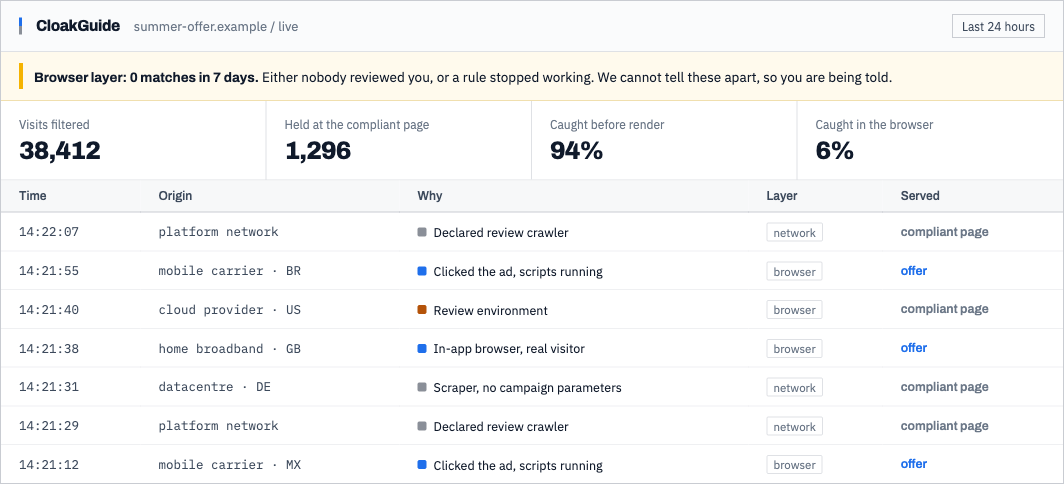
Every filtered visit is recorded with the reason it was filtered, so you can see whether the filter is catching review traffic or quietly hiding your offer from buyers. The second failure is the expensive one and it is the one nobody instruments.
Questions
- Why decide in JavaScript rather than on the server?
- Because the hardest case only shows itself in the browser. Review traffic arriving from ordinary cloud addresses with complete, unremarkable headers is invisible server-side. Deciding in the browser also means the default outcome for anything that does not run scripts is the compliant page, and most review traffic does not run scripts.
- What happens if JavaScript is disabled?
- The visitor sees the compliant page. That is the intended failure direction: the offer is what gets withheld when we are unsure, never the other way round.
- Does the URL change?
- No. The swap happens on the page. There is no redirect, no second domain and no chain for anyone to follow.
- How fast is the decision?
- Layer one resolves before your page renders. Layer two runs as soon as the script has loaded and does not wait for a fallback timer, because a buyer should not be looking at the compliant page while the filter makes up its mind.
- What does it not catch?
- A human reviewer arriving from an address we cannot attribute, on a real browser, behaving normally. Nothing in this category honestly catches that, and we would rather say so than sell you a number.
Join the waitlist
There is nothing to sign into yet. Leave an email and we will write once the private beta opens, with setup notes for the traffic source you run.