Facebook Ads
Facebook ads cloaking
Meta runs two networks with two completely different behaviours, and most filters treat them as one. CloakerHQ does not, because we measured both on live campaigns before writing a line of the filter.
Meta's crawler and reviewers
Crawler range: automated, gone in a tenth of a second, never runs your scripts. Corporate range: a person, several minutes, a real browser.
The compliant page, which has to survive a full checkout because that is what the human does.
People who clicked your ad
Consumer and mobile networks, often the in-app browser, carrying campaign parameters.
The offer page, on the same URL.
Two networks, and the header test that separates them
The corporate range sends what a browser sends: language, fetch metadata, client hints, cookies. The crawler range sends almost none of it. It is a fetcher, and it looks like one.
No fingerprint is needed for this: the request itself says which is which. That is the whole argument for putting network attribution first and browser evidence second.
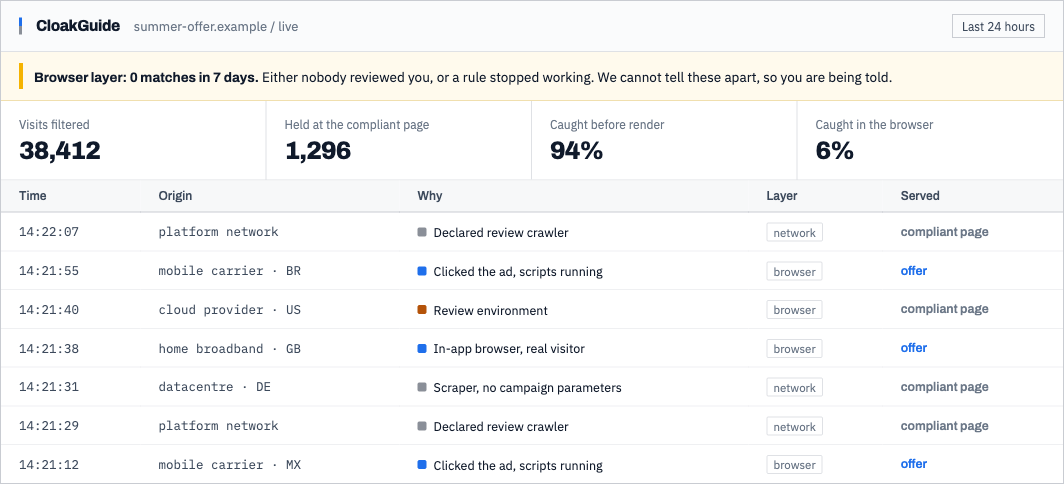
The case we do not claim to solve
Not all review traffic arrives from Meta's own ranges. Some of it comes from ordinary cloud providers with complete headers and entirely normal user agents. Server-side there is nothing to see, which is precisely why layer two exists.
But a human reviewer on a real machine from an address we cannot attribute is clean on every check there is. Nothing in this category catches that, and we would rather write it down than sell you a number. What we do instead is alarm when a rule stops matching, because rules in this layer fail silently and zero matches looks exactly like a quiet week.
Pricing
Starter
$49 / mo
- 1 site
- 50,000 filtered visits a month
One offer, one landing page, one traffic source.
Growth
$99 / mo
- 5 sites
- 250,000 filtered visits a month
Several offers running at once, across more than one platform.
Scale
$199 / mo
- Unlimited sites
- 1,000,000 filtered visits a month
Agencies and media buyers running for more than one advertiser.
Questions
- How often does a human actually review a Facebook landing page?
- Rarely, and briefly. The overwhelming majority of visits from Meta-owned addresses are automated and gone almost immediately. Human review is uncommon, lasts minutes rather than seconds, and comes from a corporate range distinct from the crawler range.
- What does a human reviewer do on the page?
- Everything. We have watched one go through an entire checkout: filling forms, submitting payment, moving between pages for several minutes. Your compliant page has to survive that, and no filter does that part for you.
- Can the two Meta networks be told apart from the request alone?
- Yes, and header completeness is the tell. The corporate range sends what a browser sends. The crawler range sends the minimum. One browses, the other fetches, and layer one separates them on that without needing anything from the browser.
- Is a platform crawler token proof of review?
- No, and treating it that way is the most common way to lose money here. Plenty of requests carrying those tokens arrive from home broadband with full headers, campaign parameters and scripts running: they are customers inside the in-app browser. CloakerHQ never filters on the token alone.
- Does fingerprinting identify Meta reviewers?
- A small number of environment signals do most of the work, and they are not the ones the category advertises. We do not list them, because a rule in this layer stops working the moment the platform reconfigures around it. What is safe to say is that the automation flag most tools lean on does not fire on ad review at all.
Join the waitlist
There is nothing to sign into yet. Leave an email and we will write once the private beta opens, with setup notes for the traffic source you run.